Section 3
Indian History and Civilization
Understand India's long history through timelines, short lessons, maps and links to original sources. Tap any lesson to open it.
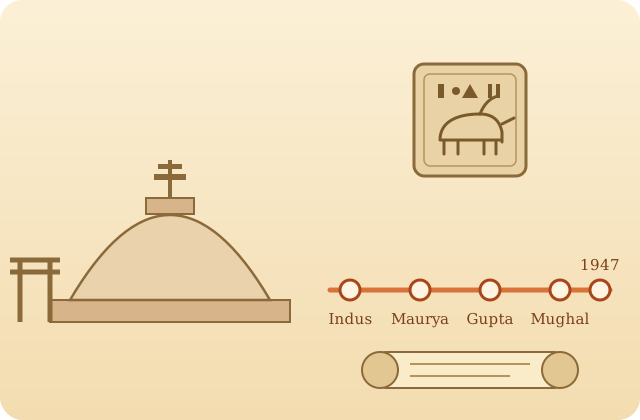
Timeline at a glance
Dates for early periods are approximate. Historians refine them as new evidence appears.
Lessons
3.1 India Before History: Landscapes and Early Societies
To understand India's history, start with its land. The Himalayas form a high wall to the north and feed great rivers with snow-melt. Below them, the Indo-Gangetic plains are some of the most fertile land on Earth. The Deccan plateau fills the south-centre, framed by the Western and Eastern Ghats. Long coastlines connected India to Africa, Arabia and Southeast Asia.
Rivers and monsoons decided where people settled. Rivers gave water, fertile silt and transport routes. The seasonal monsoon decided when to plant and harvest, and that rhythm still shapes many festivals today.
Early humans lived in the subcontinent for a very long time. The painted rock shelters of Bhimbetka in Madhya Pradesh, a UNESCO World Heritage Site, preserve thousands of years of rock art. Farming villages such as Mehrgarh (in today's Pakistan) show people growing wheat and barley and keeping cattle from around 7000 BCE.
How do we know?
- Excavations uncover buildings, streets and burials.
- Artifacts such as pottery, tools, beads and seals show daily life and trade.
- Inscriptions on rock, pillars and copper plates record decisions of rulers.
- Coins reveal rulers' names, dates, trade and even religious symbols.
- Texts such as religious works, poems, travellers' accounts and court histories add voices, each with its own viewpoint.
3.2 Indus Valley Civilization
Around 4,500 years ago, one of the world's earliest urban civilizations flourished along the Indus river and its neighbours, at the same time as ancient Egypt and Mesopotamia. Archaeologists call it the Indus Valley or Harappan Civilization, after Harappa, the first city found.
Key sites
- Harappa and Mohenjo-daro are now in Pakistan. Mohenjo-daro's "Great Bath" is one of its best-known structures.
- Dholavira (Gujarat) has remarkable water reservoirs. It was declared a UNESCO World Heritage Site in 2021.
- Rakhigarhi (Haryana) is one of the largest known Harappan sites.
- Lothal (Gujarat) has a large basin that many archaeologists interpret as a dockyard.
What made these cities special
Streets were laid out in a grid. Houses were built of standard-sized baked bricks, and covered drains ran along the streets, a level of public sanitation rare in the ancient world. Weights were standardised across a huge area. Seals, beads and pottery travelled far, and Indus goods have been found in Mesopotamia.
What we still don't know
The Indus script has not been deciphered. We don't know for certain what language people spoke, how they were governed, or exactly what they believed. Claims that confidently link the Indus people to one later community or religion go beyond the evidence. Careful historians say "we don't yet know" where the evidence is silent.
3.3 Vedic Age and Early Kingdoms
After the Indus cities declined, a new period began, known from its texts, the Vedas. The Rigveda, a collection of hymns in early Sanskrit, is among the oldest surviving texts in any Indo-European language. It was passed down orally with extraordinary precision for centuries before it was written. UNESCO recognises the tradition of Vedic chanting as intangible cultural heritage.
Later Vedic literature, including the Brahmanas and the Upanishads, explored ritual and deep philosophical questions about the self and reality. Over time, tribal groups settled into territories called janapadas. By the 6th century BCE, sixteen larger mahajanapadas had formed, such as Magadha, Kosala, Vatsa and Avanti. Towns grew, coins appeared and trade expanded.
This was also an age of debate. Teachers questioned ritual and asked how to live well. Mahavira taught Jainism's path of non-violence and self-discipline. Siddhartha Gautama, the Buddha, taught the Middle Way. Other schools argued for materialism, fate or devotion.
By the 4th century BCE, Magadha (in today's Bihar) had become the strongest kingdom. That set the stage for the Mauryas.
3.4 Maurya Empire

Around 322 BCE, Chandragupta Maurya took power in Magadha and built an empire that eventually stretched across most of the subcontinent. Tradition links him with the strategist Kautilya (also called Chanakya). The Arthashastra, a treatise on statecraft, economics, law and spying, is associated with him, though scholars debate its date and authorship.
His grandson Ashoka (reigned c. 268–232 BCE) is one of history's most remarkable rulers. After the bloody conquest of Kalinga (in today's Odisha), his own inscriptions express deep remorse. He turned towards Buddhist ethics and a policy he called dhamma: kindness to living beings, respect for parents and teachers, and tolerance among religious groups.
What the Mauryas left behind
- Edicts carved on rocks and polished stone pillars across India, mostly in Prakrit using the Brahmi script
- Stupas, such as the core of the Great Stupa at Sanchi
- The Lion Capital from Sarnath, now the basis of India's national emblem
- An organised administration with provinces, officials, taxes, roads, and public works like wells and rest-houses
Primary source: from Ashoka's Rock Edict XII (paraphrased)
The king honours people of all faiths. Real honour means growing in the essentials of one's own faith while restraining speech: not praising one's own faith or criticising another's without reason. Whoever honours another's faith also strengthens their own.
This is our plain-English paraphrase of the edict's main idea. Read scholarly translations through the Indian Culture Portal and museum collections.
3.5 Gupta Era
After the Mauryas, the subcontinent was shared by many powers: Shungas, Satavahanas, Indo-Greeks, Shakas and the Kushanas, whose trade links reached Rome and China. From around 320 CE, the Gupta dynasty, starting in Magadha, built a large kingdom across north India. Rulers such as Samudragupta and Chandragupta II are famous, and regional kingdoms like the Vakatakas were closely allied with them.
The Gupta period is often called a "classical age" for its achievements:
- Literature: Kalidasa's play Abhijnanashakuntalam and poem Meghaduta are masterpieces of Sanskrit writing.
- Mathematics and astronomy: Aryabhata (born 476 CE) wrote that the Earth rotates on its axis and calculated π closely. Indian mathematicians developed the decimal place-value system, which later travelled through the Arab world to Europe. Zero as a full number was formalised by Brahmagupta in the 7th century.
- Art and architecture: Early stone temples such as at Deogarh, and graceful Buddhist sculpture from Sarnath. The famous Ajanta paintings were mostly made under the Vakatakas, and Ellora's caves came a little later.
- Learning and trade: Nalanda began to grow as a great centre of learning. Ships and caravans linked India with Southeast Asia, China and the Mediterranean.
3.6 Cholas and Southern India
Indian history is not only the story of the north. South India had powerful, sophisticated kingdoms with their own languages, literatures and political systems.
Sangam literature, early Tamil poetry from roughly the first centuries BCE and CE, describes love, war, kings, trade and landscapes in rich detail. The early Cholas, Cheras and Pandyas appear in these poems.
The Imperial Cholas rose from the 9th century CE. Rajaraja I built the magnificent Brihadisvara Temple at Thanjavur (completed around 1010), now part of the UNESCO site "Great Living Chola Temples." His son Rajendra I sent a naval expedition to the Srivijaya kingdom in Southeast Asia and founded a new capital, Gangaikonda Cholapuram.
- Local self-government: Inscriptions at Uttaramerur describe village assemblies chosen through a lottery (kudavolai) system.
- Temple economy: Great temples were also banks, employers, schools and centres of music and dance.
- Chola bronzes: Made with the lost-wax method, including the celebrated Nataraja (Shiva as the cosmic dancer).
- Bhakti: Tamil devotional poet-saints, the Alvars and Nayanars, inspired devotional movements that spread across India.
Other southern powers
The Pallavas built the shore temples of Mahabalipuram. The Pandyas ruled from Madurai, and the Cheras ruled along the Kerala coast. The Chalukyas and Rashtrakutas ruled the Deccan; the Rashtrakutas created Ellora's rock-cut Kailasa temple. The Vijayanagara Empire (1336–1646) built Hampi, one of the largest cities of its time.
3.7 Delhi Sultanate and Mughal Empire
The Delhi Sultanate (1206–1526) was a series of five dynasties (Mamluk, Khalji, Tughlaq, Sayyid and Lodi) that ruled from Delhi. They built the Qutb Minar, ran a system of land revenue and markets, and defended north India against Mongol invasions. Persian became a language of administration, while new forms of music, architecture and poetry developed through exchange. Amir Khusrau is a famous example.
The Mughal Empire began when Babur won the First Battle of Panipat in 1526. Key rulers:
- Indo-Islamic architecture includes domes, arches, minarets, charbagh gardens, forts and stepwells.
- Languages met: Persian, Arabic and Turkic mixed with Sanskrit, Hindavi and regional languages. Urdu and Hindi share deep roots from this period.
- Culture: Mughal miniature painting, Hindustani music at court, Mughlai cuisine, fine textiles and carpets.
- Resistance and regional powers: Rajput kingdoms, the Ahoms in Assam, the Sikh Gurus and later Sikh misls, the Marathas and southern kingdoms all shaped events.
3.8 Marathas and Regional Powers
Chhatrapati Shivaji Maharaj (1630–1680) built an independent Maratha state in the western Deccan. He used hill forts, fast cavalry and a navy along the Konkan coast. He was crowned at Raigad in 1674. His administration had a council of eight ministers (the Ashta Pradhan) and promoted the use of Marathi in government.
In the 18th century, the Peshwas (chief ministers) based in Pune led a Maratha confederacy that included families such as the Scindias, Holkars, Gaekwads and Bhonsles. Maratha power reached Delhi, but the Third Battle of Panipat (1761) against Ahmad Shah Abdali was a major setback. The Anglo-Maratha Wars ended Maratha independence in 1818.
India before British rule was politically diverse
- Sikhs: Maharaja Ranjit Singh built a strong kingdom in Punjab, with its capital at Lahore.
- Rajputs: Kingdoms such as Mewar, Marwar and Amber.
- Nizams of Hyderabad and the Nawabs of Awadh, Bengal and Arcot.
- Mysore: Hyder Ali and Tipu Sultan fought four wars with the British.
- Travancore, the Ahoms of Assam and many smaller states.
3.9 Colonial Rule and the Freedom Movement
The East India Company came to trade, but after the battles of Plassey (1757) and Buxar (1764) it won the right to collect revenue in Bengal. Over the next century it moved from trade to territorial control through wars, alliances and annexations.
In 1857, a mutiny by sepoys at Meerut grew into a widespread uprising across north and central India, with leaders such as Rani Lakshmibai of Jhansi, Tatya Tope, Begum Hazrat Mahal and Bahadur Shah Zafar. After it was suppressed, the British Crown took direct control in 1858.
Colonial rule: the impact
Railways, telegraphs, universities and a modern legal system arrived, built mainly to serve imperial needs. At the same time, heavy land taxes, the decline of traditional industries such as handloom textiles, and severe famines (including the Bengal Famine of 1943) caused great suffering. Economic historians still debate the scale of "drain" of wealth from India.
Many movements, many people
- Indian National Congress (founded 1885) grew from petitions into a mass movement.
- Social reformers such as Raja Ram Mohan Roy, Savitribai and Jyotirao Phule, and Sree Narayana Guru challenged injustice.
- Gandhi's mass campaigns included Non-Cooperation (1920–22), the Salt March (1930) and Quit India (1942).
- Revolutionaries such as Bhagat Singh, Chandrashekhar Azad and Ram Prasad Bismil.
- Subhas Chandra Bose led the Indian National Army.
- B. R. Ambedkar fought caste discrimination and chaired the Constitution's drafting committee.
- Leaders such as Bal Gangadhar Tilak, Jawaharlal Nehru, Sardar Vallabhbhai Patel, Maulana Abul Kalam Azad, Sarojini Naidu and Khan Abdul Ghaffar Khan.
- The All-India Muslim League (founded 1906) increasingly argued for a separate homeland.
- Women, workers, farmers, students, tribal and peasant movements, and countless local struggles.
Partition
Independence on 15 August 1947 came with the Partition of British India into India and Pakistan. Millions of people were displaced, and hundreds of thousands to perhaps two million died in communal violence. Many families in India, Pakistan and Bangladesh still carry these memories. Partition's causes are debated, including colonial policy, political negotiations and communal tensions, and it deserves to be discussed with care and compassion.
The Constitution
India's Constituent Assembly adopted the Constitution on 26 November 1949. It came into force on 26 January 1950, now celebrated as Republic Day.
Primary source: opening of the Preamble
"WE, THE PEOPLE OF INDIA, having solemnly resolved to constitute India into a SOVEREIGN SOCIALIST SECULAR DEMOCRATIC REPUBLIC…"
Read the full text at the Legislative Department, Government of India.
3.10 Modern India
Since independence, India has developed as the world's largest constitutional democracy, holding regular elections with hundreds of millions of voters.
India's culture travels the world through cinema, music, food, yoga, cricket, tech and startups, and a global diaspora of tens of millions of people.
Continuing challenges
Like every country, India faces ongoing questions. They include inequality and poverty, environmental pressure on air, water and forests, gender equality, religious and social harmony, and uneven regional development. Indians debate these openly. Learning about them is part of understanding India honestly.
"History is not a list of kings and battles. It is the story of how people built cities, made art, traded across oceans, argued about ideas, resisted injustice, and created the India we know today."