Section 6
Music, Dance, and Arts
Indian performing and visual arts, made approachable for beginners, families and curious learners. Each module covers where an art comes from, its key ideas, a few words to know, and something to try at home.
Classical dance
India's classical dances grew from the ideas in the Natya Shastra, an ancient text on performance attributed to Bharata Muni. They combine three things. Nritta is pure rhythmic movement. Nritya is expressive storytelling. Natya is drama. Dancers tell stories with mudras (hand gestures) and abhinaya (expression).
6.1 Bharatanatyam
From: Tamil Nadu. It grew from temple and court traditions and was revived and re-shaped in the 20th century by artists such as Rukmini Devi Arundale and the Thanjavur Quartet's lineage of teachers.
Look for: the aramandi (half-sitting position with knees turned out), crisp geometric lines, sharp footwork, and expressive storytelling.
A typical performance (margam) moves from an invocation (alarippu) through pure-dance pieces (jatiswaram), to expressive storytelling (varnam, padam) and a fast finale (tillana).
6.2 Kathak
From: North India. Its name comes from katha (story), and it began with travelling storytellers. Later it flourished in both temples and Mughal and Rajput courts. Major schools (gharanas) are Lucknow, Jaipur and Banaras. Pandit Birju Maharaj was one of its best-known modern masters.
Look for: lightning-fast spins (chakkars), intricate footwork with ankle bells (ghungroo), and playful exchanges with the tabla player.
6.3 Other classical dance forms
Odissi (Odisha)
Flowing curves and the tribhanga pose (body bent in three places), inspired by temple sculptures. Costume: silver jewellery, Sambalpuri or Bomkai silk.
Kuchipudi (Andhra Pradesh)
Lively dance-drama; dancers sometimes perform on the rim of a brass plate.
Kathakali (Kerala)
Dramatic dance-theatre with spectacular painted faces and costumes, telling Ramayana and Mahabharata stories.
Mohiniyattam (Kerala)
Gentle, swaying movements like palm trees in the breeze; white-and-gold costume.
Manipuri (Manipur)
Soft, rounded movements and devotional themes such as the Ras Lila; dancers wear distinctive barrel-shaped skirts.
Sattriya (Assam)
Created in the 15th–16th centuries by the saint Srimanta Sankardev and preserved in Vaishnava monasteries (satras).
Classical music
Both of India's classical systems are built on raga (a melodic framework with its own mood, notes and phrases) and tala (a rhythmic cycle). Music is mostly learned by ear from a guru, and improvisation is central.
The seven notes are Sa Re Ga Ma Pa Dha Ni, like do-re-mi.
6.4 Carnatic music (South India)
Carnatic music is mainly devotional and song-centred. Purandara Dasa (16th century) is called the father of Carnatic music for his teaching method. The "Trinity" of composers, Tyagaraja, Muthuswami Dikshitar and Syama Sastri (18th–19th centuries), wrote many of the kritis (compositions) still sung today. M. S. Subbulakshmi became one of its most loved voices worldwide.
Key words: melakarta (a system of 72 parent ragas) · kriti (composition) · alapana (slow improvised raga exploration) · Adi tala (8-beat cycle).
Typical ensemble: vocalist, violin, mridangam, ghatam (clay pot), kanjira.
6.5 Hindustani music (North India)
Hindustani music developed in temples and royal courts, with strong Persian influences. Tansen, a musician at Akbar's court, is legendary. Different family schools (gharanas) have their own styles. Modern greats include Pandit Ravi Shankar (sitar), Ustad Bismillah Khan (shehnai), Bhimsen Joshi (vocal) and Ustad Zakir Hussain (tabla).
Styles: dhrupad (ancient, meditative) · khayal (the most common vocal form, more ornamented) · thumri (light and romantic).
Time and season: Many ragas belong to a time of day: Bhairav at dawn, Yaman in the evening. Malhar ragas are linked with the monsoon.
Tabla

The tabla is a pair of drums, central to Hindustani music, Kathak and devotional singing. The smaller wooden drum (dayan) is played with the dominant hand and tuned to a precise pitch. The larger metal or clay drum (bayan) gives deep bass sounds that the player can bend by pressing with the wrist. The black circle on each head (syahi) is a paste of iron filings, flour and gum that gives the tabla its ringing tone.
Bols are spoken syllables for each stroke: Dha, Dhin, Ta, Tin, Na, Ge, Ke. Tabla players often recite a pattern aloud before playing it.
Teentaal, the most common cycle, has 16 beats in four groups:
Dha Dhin Dhin Dha | Dha Dhin Dhin Dha | Dha Tin Tin Ta | Ta Dhin Dhin Dha
Bollywood dance history
Bollywood dance is a modern popular form shaped by Indian classical and folk dance, global styles and the needs of the camera. ("Bollywood" refers to Hindi cinema made in Mumbai. India also has major Tamil, Telugu, Malayalam, Kannada, Bengali and other film industries.)
Visual and folk arts
 6.8
Rangoli
Rangoli is floor art drawn at doorways to welcome guests and good fortune, especially at festivals. It uses rice flour, coloured powder or flowers.
Regional names: kolam (Tamil Nadu), muggulu (Andhra and Telangana), alpana (Bengal), mandana (Rajasthan), aripan (Bihar), chowk purana (Uttar Pradesh), jhoti or chita (Odisha), rangavalli (Karnataka) and pookalam (Kerala, made with flowers).
Rice-flour kolams also feed ants and birds, a small daily act of sharing.
 6.9
Warli art
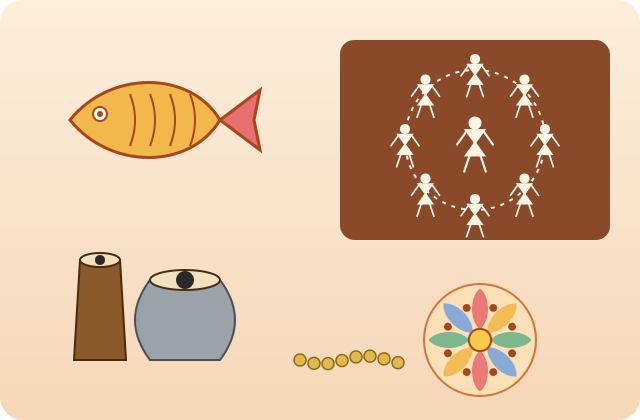
Warli art is a tribal art tradition from Maharashtra, made by the Warli people of the Palghar–Thane region. It uses only circles, triangles and lines in white (rice paste) on a red-brown mud wall to show farming, dancing, hunting and celebrations. The tarpa dance, with people in a spiral, is a favourite theme. Jivya Soma Mashe brought Warli art to the world.
Madhubani painting
Madhubani, or Mithila art, is a traditional painting style from the Mithila region of Bihar (and Nepal). It was once painted by women on walls and floors for weddings and festivals. After a drought in the 1960s, artists such as Sita Devi and Ganga Devi moved it onto paper, and it became famous worldwide.
Look for: double outlines, no empty space (gaps are filled with patterns), natural colours, and fish, peacocks, lotuses, the sun and moon, and scenes from epics.
Classical instruments library
Indian instruments fall into four ancient groups: tata (strings), sushira (wind), avanaddha (skin drums) and ghana (solid, like bells and cymbals).
Sitar · strings
Long-necked, with curved frets and "sympathetic" strings that ring by themselves. Hindustani.
Veena · strings
The Saraswati veena is the ancient lute of Carnatic music; the goddess Saraswati is shown holding it.
Sarod · strings
Fretless with a metal fingerboard, giving a deep, gliding sound. Hindustani.
Sarangi · bowed strings
Carved from one block of wood; its sound is often compared to the human voice.
Santoor · struck strings
A trapezoid box of about 100 strings struck with light hammers. From Kashmir.
Violin · bowed strings
Arrived from Europe and became essential to Carnatic music, played seated with the scroll resting on the foot.
Bansuri · wind
A bamboo flute associated with Krishna. Pandit Hariprasad Chaurasia made it a concert star.
Shehnai and nadaswaram · wind
Double-reed instruments played at weddings and temples. The shehnai is northern; the nadaswaram is southern.
Mridangam · drum
A double-headed barrel drum, the main rhythm instrument in Carnatic music and Bharatanatyam.
Ghatam · clay pot
A clay pot played with fingers, palms and even the belly of the pot. Carnatic.
Harmonium · reeds
A hand-pumped keyboard that came from Europe in the 19th century and is now everywhere in bhajans, qawwali and film music.
Tanpura · drone
Four or five strings plucked in a loop to create the constant drone that every raga rests upon.